Experienced Technicians
Our team is well-equipped and skilled to handle any water heater problem, thus giving you accurate and reliable solutions.

Our team is well-equipped and skilled to handle any water heater problem, thus giving you accurate and reliable solutions.
Your home will be treated with the utmost respect while ensuring the disruption caused during the service is minimized.
We always focus on recommending systems and services that will save you money in the long run.
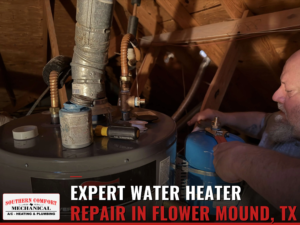 You turn on the shower expecting warm water, and instead you’re greeted with a cold shock, or worse, water that never quite gets hot at all. A failing water heater has a way of announcing itself at the least convenient moment, whether that’s right before work or in the middle of hosting family for the holidays.
Knowing what’s actually wrong, and when to call for professional water heater repair in Flower Mound, TX, can save you from a much bigger headache down the road — and it’s exactly the kind of diagnostic expertise you’d expect from an expert plumber that handles the full range of home comfort and plumbing needs.
Water heater repair addresses issues like inconsistent temperatures, unusual noises, leaks, and discolored water, which are typically caused by sediment buildup, a faulty heating element or thermostat, ignition problems, or a failing component like the anode rod or pressure relief valve. A qualified technician can diagnose the specific cause and determine whether a repair will resolve the issue or if replacement makes more sense.
Below, we’ll walk through the most common signs of water heater trouble, what typically causes these issues, how tank and tankless systems differ when it comes to repairs, and how to decide between repairing and replacing your unit.
A water heater rarely fails without warning. Watch for these signs that it’s time to schedule repair service:
If you’re noticing one or more of these signs, addressing it early can often prevent a more serious, and more expensive, failure later on.
Understanding what typically causes these symptoms can help you recognize the right kind of service call:
Traditional tank water heaters store and continuously heat a set volume of water, which means sediment buildup is one of the most common maintenance issues over time. Flushing the tank periodically helps reduce sediment accumulation and supports more efficient, longer-lasting performance. Common tank water heater repairs involve the heating element, thermostat, pilot light assembly, or anode rod.
Tankless water heaters heat water on demand rather than storing it, which eliminates some of the sediment-related issues common to tank models but introduces its own maintenance considerations, particularly around mineral scale buildup in the heat exchanger. Because tankless systems have smaller, more specialized components, repairs are generally best left to a technician experienced specifically with tankless equipment.
Not every water heater issue calls for a full replacement, but knowing when repair no longer makes sense can save you money in the long run. Consider:
A professional evaluation can give you a clear, specific recommendation based on your unit’s age, condition, and repair history, rather than leaving you to guess.
A thorough water heater repair typically follows a few key steps:
Regular maintenance is one of the most effective ways to avoid unexpected water heater repairs. Consider these preventative steps:
Consider the age of your unit, how often it’s needed repairs recently, and the severity of the current issue. A unit under eight years old with a single, isolated problem is often a good candidate for repair, while an older unit with a history of repeated issues, or significant tank corrosion, is generally better replaced.
These noises are typically caused by sediment buildup at the bottom of the tank. As water heats and moves through the trapped sediment, it can create popping or rumbling sounds. A professional tank flush can often resolve this issue.
Most traditional tank water heaters last 8 to 12 years, while tankless water heaters often last 15 to 20 years with proper maintenance. Actual lifespan depends significantly on water quality, usage, and how consistently the unit has been maintained.
No, any leak from a water heater should be evaluated promptly. Leaks can come from loose fittings, a failing pressure relief valve, or, in more serious cases, corrosion inside the tank itself, which typically indicates the unit needs to be replaced rather than repaired.
Some basic maintenance, like checking for visible leaks, can be done by homeowners, but most water heater repairs involve gas connections, electrical components, or pressurized systems that are best handled by a licensed technician for both safety and long-term reliability.
That’s why our Southern Comfort Mechanical team is ready to answer any water heater emergency call without prior notice. We’ve trained our service technicians to provide fast and efficient service for your clients. They’re well informed on the best practices for using the equipment and latest technology to ensure that any water heater problem is solved once and for all.
When you choose us, here’s what you can count on:

A malfunctioning water heater disrupts your daily routine in a way few other home issues do. Whether you’re dealing with inconsistent temperatures, strange noises, or a leak you’ve noticed near the tank, getting an accurate diagnosis is the first step toward a lasting fix.
Southern Comfort Mechanical has served Flower Mound, TX and the surrounding Denton County area with honest, upfront pricing and dependable service since 2007. Our licensed technicians repair both gas and electric water heaters, including tankless systems, and will walk you through exactly what’s needed to get your hot water back.
Call us today at 469-830-1990 or contact us online to schedule water heater repair in Flower Mound, TX.


Argyle
Bartonville
Carrollton
Coppell
Copper Canyon
Corinth
Denton
Double Oak
Flower Mound
Frisco
Highland Village
Lake Dallas
Lantana
Lewisville
Little Elm
Roanoke
Shady Shores
Southlake
The Colony

We service all makes, models and brands of HVAC equipment and keep our trucks fully stocked with the parts and tools needed to carry out your repair.
174 Lake Park Rd
Lewisville, TX 75057
469-702-0701
4017 Pepperwood Drive
Flower Mound 75028
469-830-1990
License #TACLA104577C
Plumbing License #M36523
Texas State Board
of Plumbing Examiners
929 E 41st Street Austin TX 78751
(512) 936- 5200

© 2026 Copyright Southern Comfort Mechanical. License #TACLA104577C.
Privacy Policy. App Privacy Policy. HVAC Marketing by Proven Marketing Now | Service Area | Terms of Use